
Bubble Point Definition
Definition and Principle
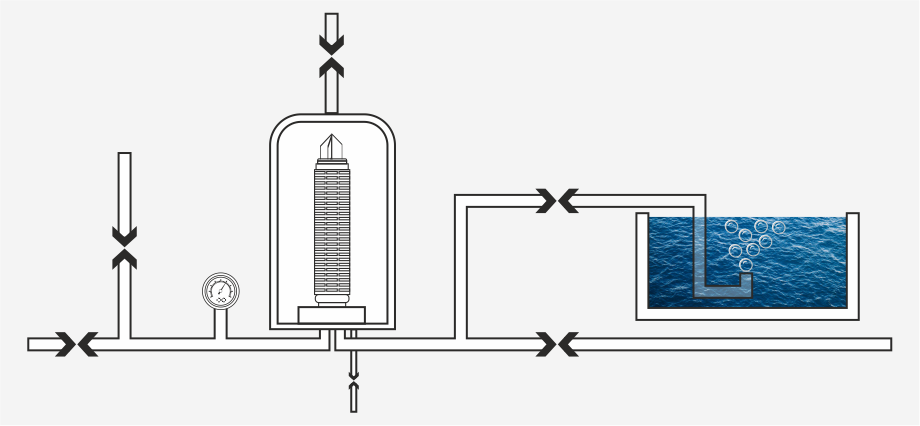
A bubble point test is a test designed to determine the pressure at which a continuous stream of bubbles is initially seen downstream of a wetted filter under gas pressure. To perform a Bubble Point Test, gas is applied to one side of a filter, with tubing downstream of the filter submerged in a bucket of water. The filter must be wetted uniformly so that water fills all the voids within the filter media. When gas pressure is applied to one side of the membrane, the test gas will dissolve into the water, to an extent determined by the solubility of the gas in water. Downstream of the filter, the pressure is lower. Therefore, the gas in the water on the downstream side is driven out of solution. As the applied upstream gas pressure is increased, the diffusive flow downstream increases proportionally. At some point, the pressure becomes great enough to expel the water from one or more passageways establishing a path for the bulk flow of air. As a result, a steady stream of bubbles should be seen exiting the submerged tubing. The pressure at which this steady stream is noticed is referred to as the bubble point.
Procedure
The process for bubble-point test is described in American Society for Testing and Materials Standard (ASTM) Method F316. The top of the filter is placed in contact with the liquid, the bottom with air, the filter holder is connected to a source of a regulated pressure. The air pressure is continuously increased and the formation of bubbles on the liquid side is noted. At pressures below the bubble point, gas passes across the filter only by diffusion, but when the pressure is high enough to dislodge liquid from the pores, bulk flow begins, and bubbles will be seen. The initial bubble test pressure concludes the size (and location) of the largest hole, the open bubble point pressure determines the mean pore size of the element. The latter may be affected by flow velocity as well as pressure. The theoretical relation between this transition pressure and the bubble-point pressure is:
D = (4g x cos q) / P
Where:
P = bubble-point pressure
g = surface tension of the liquid (72 dynes/cm for water)
q = liquid-solid contact angle (which for water is generally assumed to be zero)
D = diameter of the pore
Since no pores in a realistic filter element are likely to be shaped like capillary tubes it is crucial to introduce a shape correction factor K into the formula. Since g and q are constant, the formula can be simplified by presenting an empirical factor K1 dependent on the filter material and form of the units employed:
D = K1 / P
D is the maximum average diameter of the pores in mm.
Test Method
- Record the filter part number(s), lot number, and product information. Also include physical observations.
- Wet the filter to be tested with water.
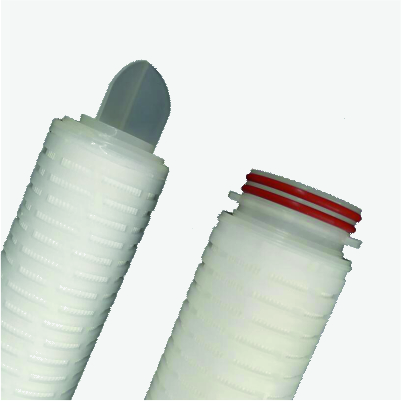
- Place the wetted filter in the appropriate housing.
- Connect the outlet fitting from the compressed air pressure regulator to the upstream side of the test filter. Check that the gauge which is connected to the pressure regulator has subdivisions of at least 0.5 psig and has the capacity to measure up to 100 psig. A digital pressure gauge can also be used.
- Connect the outlet fitting from the compressed air pressure regulator to the upstream side of the test filter.
- Connect a piece of flexible tubing from the downstream port of the test filter into a beaker filled with water.
- Starting from zero pressure, gradually increase the pressure to the test filter using the pressure regulator.
- Observe the submerged end of the tubing for the production of bubbles as the upstream pressure is slowly increased in 0.5 psig increments. Note the rate that the bubbles appear for the end of the submerged tube.
- The bubble point of the test filter is reached when bubbles are produced from the tube at a steady rate. Record the pressure to the nearest 0.5 psig as indicated on the pressure gauge.
Test Considerations
- Ensure that the filter is thoroughly and uniformly wet such that all the pores are filled with water. Failure to wet the filter may result in premature air flow resulting in false failure.
- Diffusive flow of air through the filter will occur at pressures lower than the bubble point. Ensure that the pressure recorded is in fact the pressure at which a steady stream of bubbles is noted.
- If failure occurs open the filter housing to ensure that the filter is installed correctly in the housing. Replace the housing cover and retest. If another failure is recorded remove and dispose of the filter element.
Advantages
One of the great benefits of the bubble point test is that it can be implemented on filters under actual use conditions and with any filter. It is a non-destructive test, in this manner it does not contaminate the filter and so can be used to conclude the integrity of a filter at any time, as well as establishing the absolute rating. Henceforth, with further advantages in computer software and control, it may be attainable to use the data on flow rate or pressure increases to more accurately determine what happens in a sample before the bubble point is reached, such as diffusion.